SETTING UP A NEGOTIATION TEAM – [PART III]
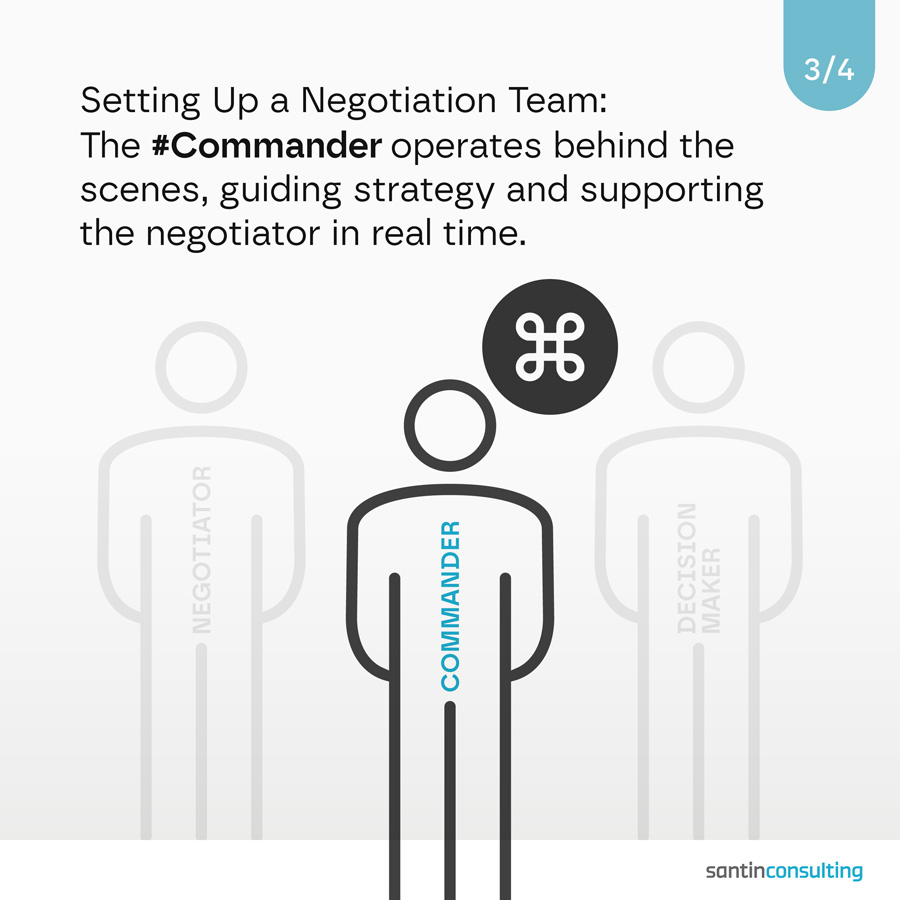




In the previous post, we described the role of the Negotiator. Let’s now focus on the Commander in a negotiation team—a role that is just as important as the negotiator, if not more so.
If the negotiator speaks, the commander thinks, guides, and controls.
The Negotiation Commander operates behind the scenes, guiding strategy and supporting the negotiator in real time.
While not leading the dialogue, the commander ensures coherence, discipline, and strategic alignment throughout the negotiation.
Core Characteristics of an Effective Commander:
Strategic Thinking
Maintains overall objectives, aligns tactics, and anticipates counterpart strategies.
Situational Awareness
Observes verbal and non-verbal signals, reads the emotional climate, and identifies emerging opportunities and risks.
Decision Support & Guidance
Ensures that concessions and commitments follow a clearly defined strategy.
Emotional Control & Stability
Acts as an emotional anchor for the team, maintaining composure under pressure.
Discipline & Process Control
Keeps the negotiation on track and within agreed boundaries, agendas, and mandates.
Analytical & Tactical Insight
Assesses offers and counteroffers against BATNA, red lines, and priorities.
Authority & Credibility
Intervenes when necessary, with clarity, purpose, and legitimacy.
Ethics & Integrity
Protects the organization’s reputation and long-term interests.
It is crucial for the commander to avoid speaking out of turn or undermining the negotiator. As the emotional anchor of the team, the commander must not react emotionally or visibly to provocations, preserving stability and strategic focus.
Join our Learning Sessions to gain deep knowledge about:
ADVANCE NEGOTIATION
This program is designed for senior purchasers involved in complex, high-stakes negotiations. It develops advanced negotiation skills, strategic thinking, and influence techniques to optimize outcomes in both bilateral and multilateral environments. Participants gain a structured, practical approach and immediately applicable tools to manage complex negotiations more effectively, increase their impact, and achieve superior results.
STRATEGIC PURCHASING
This training program is designed primarily for employees who are new to purchasing, but it is also highly recommended for operational purchasers who lack experience in a strategic approach. The program combines dynamic presentations, real-life examples from my professional experience, and interactive business cases that participants will actively work through. This ensures a practical, engaging, and results-oriented learning experience.
Comments are closed.