ACTIVE LISTENING IN NEGOTIATION
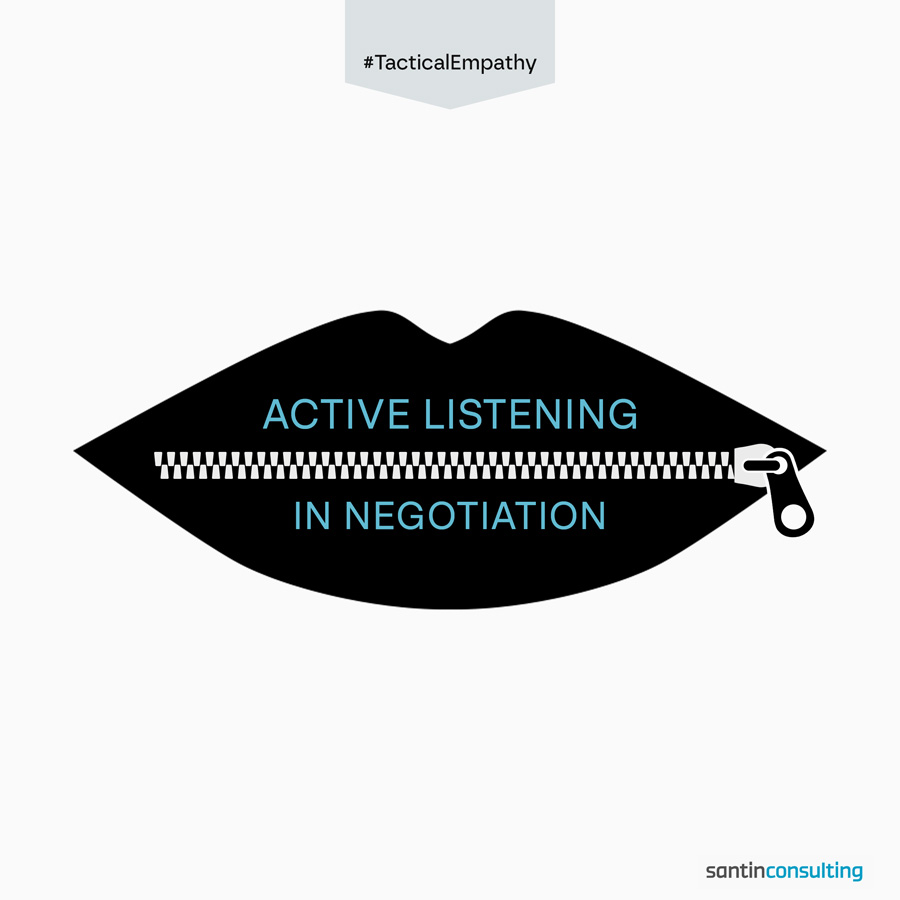



Tools commonly used in tactical empathy include: Active Listening in Negotiation. During negotiations we face two main problems when listening:
First › Selective listening. We often hear only what we want to hear, focusing on arguments that support our own position.
Second › Limited processing capacity. When we are not speaking, we are often preparing our next argument. And when we are speaking, we are defending our position.
The result is that we lose a lot of valuable information.
Even more important, the counterpart feels that they are not truly being listened to. When that happens, they will usually stop listening to us as well. Instead of having a dialogue to solve the conflict, both sides start defending their own positions and thinking about how to restate their argument more clearly.
Active listening helps overcome this problem.
The goal is not only to understand the other party’s perspective, but also to make sure that they feel heard. This creates reciprocity and opens the door to a constructive conversation.
To practice active listening, we must focus on identifying what the other party really needs. We need to hear what they are trying to say and understand their perceptions, thoughts, and emotions.
Equally important is using small signals and asking for clarification that reinforce understanding and trust. These signals help the other party feel safe and recognized.
For example: “Did I understand correctly?” or “Let me see if I follow what you’re saying…”
These small clarifications show that you are truly paying attention.
Once people feel comfortable with you as a listener, let them talk.
And talk.
And talk.
Real conversation starts when people feel heard. And the more they talk, the more information they reveal. And more information means more leverage in negotiation.
Join our Learning Sessions to gain deep knowledge about:
ADVANCE NEGOTIATION
This program is designed for senior purchasers involved in complex, high-stakes negotiations. It develops advanced negotiation skills, strategic thinking, and influence techniques to optimize outcomes in both bilateral and multilateral environments. Participants gain a structured, practical approach and immediately applicable tools to manage complex negotiations more effectively, increase their impact, and achieve superior results.
STRATEGIC PURCHASING
This training program is designed primarily for employees who are new to purchasing, but it is also highly recommended for operational purchasers who lack experience in a strategic approach. The program combines dynamic presentations, real-life examples from my professional experience, and interactive business cases that participants will actively work through. This ensures a practical, engaging, and results-oriented learning experience.
Comments are closed.