STAGES DURING NEGOTIATION
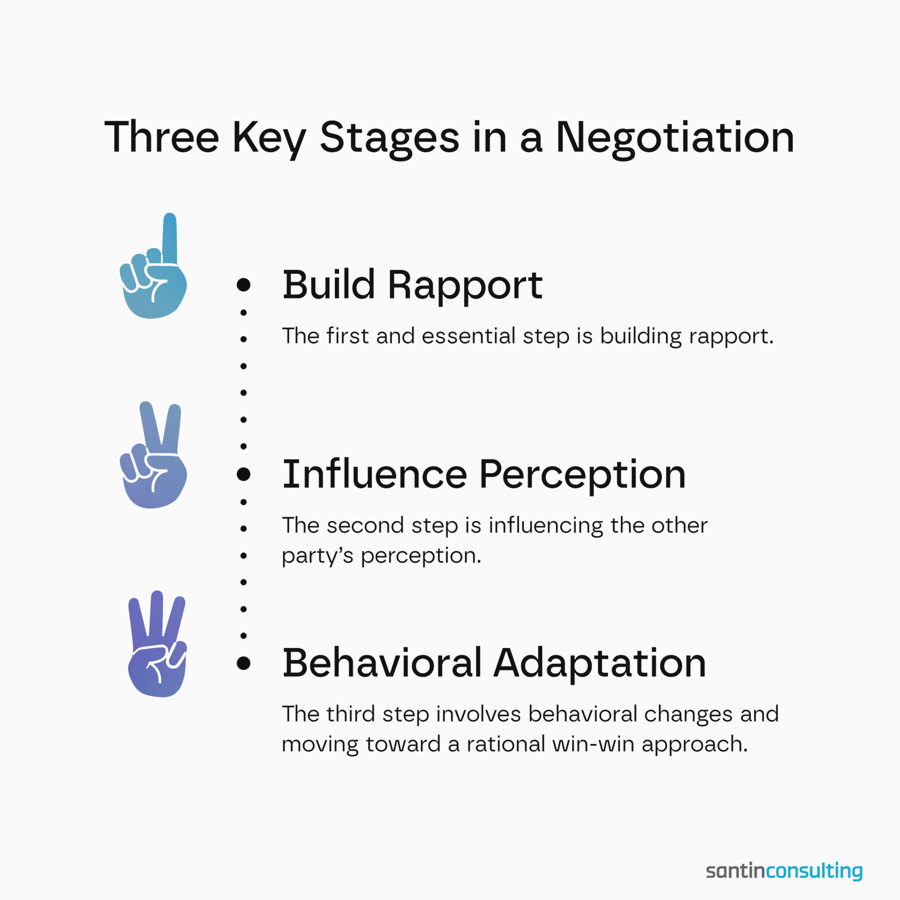
As I mentioned in my previous post, the real skill in negotiation is not choosing one “school” of negotiation but knowing when and how to use the tools from different approaches.
Based on my experience in business negotiations, I usually follow three key #steps to optimize the outcome. For me, it is very important not to skip any of them.
① Build Rapport – The first and essential step is building rapport.
Rapport creates a sense of trust, understanding, and mutual connection between negotiating parties. When rapport is strong, people become more open, flexible, and willing to collaborate. It also increases the likelihood of long-term relationships.
Some of the tools I use to build rapport include:
Equally important is authenticity. Genuine curiosity and respect are essential. If people feel manipulated, rapport disappears immediately.
② Influence Perception – The second step is influencing the other party’s perception.
In negotiations, reality is often less important than how each side perceives the situation. Influence is the ability to shape the other party’s perceptions, decisions, or behavior and guide the negotiation toward a desired outcome without using force or authority.
It is not about manipulation, but about strategically guiding the conversation. In many cases, negotiation success depends more on influence than on power.
Some tools that help influence perception include:
③ Behavioral Adaptation – The third step involves behavioral changes and moving toward a rational win-win approach.
This means adapting communication style, emotional responses, and strategic behavior to improve outcomes while maintaining the relationship.
Tools I often use in this stage include:
From my perspective, these three steps are essential.
But one principle remains critical throughout the entire negotiation process: authenticity.
The goal is not manipulation, but using the right tools to create understanding, influence perceptions, and ultimately reach a mutually valuable agreement.
Join our training sessions to gain deep knowledge about target calculation, expertise on supplier management and market analysis, a strategic mind set, well-trained abilities in cost analysis and negotiation skills. Additionally, please feel free to contact us directly for more information.
Comments are closed.